How Many Gallons Does a Tanker Truck Hold?
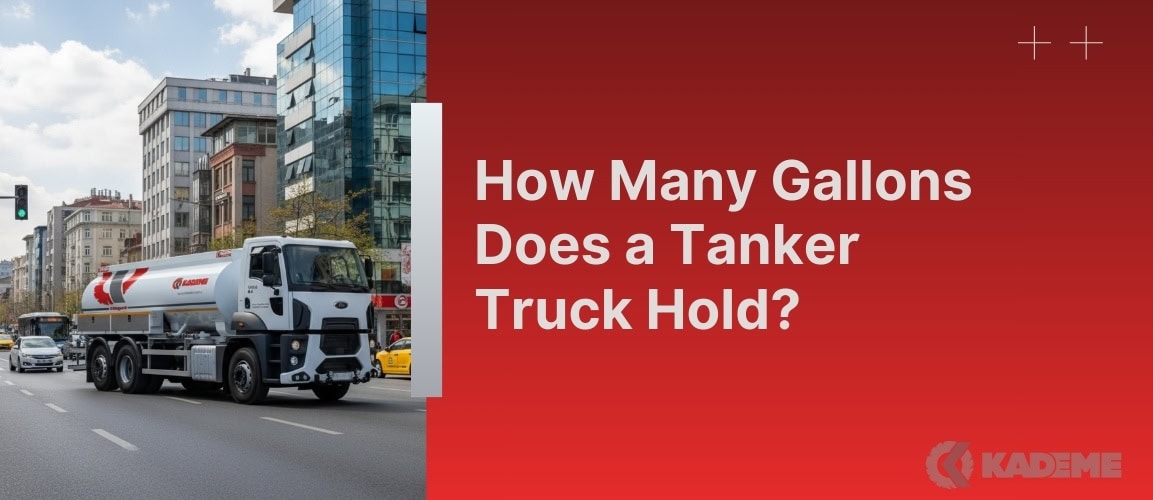
Most tanker trucks hold between 1,000 and 11,600 gallons. A large highway fuel tanker usually carries 9,000 to 11,600 gallons of gasoline or diesel, while small local delivery trucks carry 1,000 to 3,000 gallons. The real limit is not the size of the tank. Legal weight limits, the density of the cargo, the tanker design and regional rules decide how much a tanker can legally and safely carry.
Key takeaways
- A tanker truck’s capacity varies widely, from 1,000 to over 11,000 gallons, depending on its size and purpose.
- In the U.S., the 80,000-pound gross vehicle weight limit restricts the actual liquid volume more than the tank size does.
- Liquid density sets how much a truck can legally carry. Lighter liquids such as gasoline allow more volume than dense chemicals.
- Each tanker type, whether fuel, chemical, corrosive, gas or cryogenic, has its own structural and capacity limits.
- Axle weights, operating rules and regional regulations (U.S. and EU) shape the design and the usable capacity.
- The right measure is not how big the tank is, but how much it can legally and safely transport under given conditions.
Standard capacity classes
Small tanker trucks
Small tankers typically carry 1,000 to 3,000 gallons (3,785 to 11,355 liters). They are built for local delivery where agility matters, such as home heating oil, LPG or aviation fuel supply. Mounted on a light single-axle chassis, they can work in narrow streets and construction zones.
Medium tanker trucks
Medium tankers hold 3,000 to 7,500 gallons (11,355 to 28,390 liters). They balance volume with maneuverability and often serve regional fuel or milk distribution. Tandem or tri-axle layouts spread the weight better and keep the vehicle stable.
Large tanker trucks
Large highway tankers hold 5,500 to 11,600 gallons (20,820 to 43,910 liters). Some specialized models exceed 13,000 gallons where local laws allow it. These long-haul vehicles carry petroleum, chemicals or water on interstate routes. Their routes need careful planning because of bridge and clearance limits.
Why weight determines capacity
The 80,000-pound federal rule
In the United States, the maximum legal gross vehicle weight for interstate transport is 80,000 pounds (about 36,287 kg). This total includes the truck’s empty weight (tare), the cargo, the driver and the fuel. A heavy tractor or a steel tank leaves less room for cargo weight than a lighter aluminum tank.
The role of cargo density
Every liquid has its own weight per gallon. A truck that can legally carry about 7,800 gallons of gasoline (about 6.2 lbs/gal) might only haul 3,200 gallons of sulfuric acid (about 15 lbs/gal) at the same weight. Capacity therefore changes with the density of the liquid. It is a calculation, not a fixed number.
| Liquid Type | Weight (lbs/gal) | Max Legal Volume (for 48,000 lb net load) |
|---|---|---|
| Gasoline | ~6.2 | ~7,750 gal |
| Diesel | ~7.1 | ~6,760 gal |
| Water | ~8.34 | ~5,755 gal |
| Milk | ~8.6 | ~5,580 gal |
| Sulfuric Acid | ~15 | ~3,200 gal |
Axle and bridge formula limits
A vehicle can stay below 80,000 lb in total and still break the rules if the weight is badly distributed. Axle load and bridge spacing rules apply separately. Federal law limits single axles to about 20,000 lb and tandem groups to 34,000 lb. Capacity therefore also depends on how the load is spread across the chassis.
Tanker types and their typical capacities
Fuel tankers (DOT 406 / MC 306)
Fuel tankers hold 9,000 to 11,600 gal of gasoline or diesel. They are built from lightweight aluminum to maximize payload. Most are divided into several compartments so that they can carry different fuel grades at once.
Chemical tankers (DOT 407 / MC 307)
Chemical tankers carry 4,000 to 8,000 gal of corrosive or reactive chemicals. They are made from stainless steel, often insulated and rated for moderate pressure. The heavier construction reduces the usable volume.
Corrosive liquid tankers (DOT 412 / MC 312)
Corrosive liquid tankers contain 4,000 to 7,000 gal of acids. Their reinforced, rubber-lined tanks add significant tare weight.
Pressurized gas tankers (MC 331)
Pressurized gas tankers transport LPG or ammonia. “Bobtail” delivery trucks hold about 3,500 gal, while large trailers reach 11,500 gal. Their thick carbon steel shells are designed for pressures of up to 500 psig.
Cryogenic tankers (MC 338)
Cryogenic tankers move liquefied gases such as nitrogen or oxygen. Their capacity is typically 4,500 to 5,550 gal and varies by design. The double-wall insulation and vacuum systems make these tanks heavy.
Water tankers
Water tankers are used in agriculture, firefighting and construction. Road-legal units carry 2,000 to 6,000 gal. Off-road mining water trucks can exceed 60,000 gal because highway weight limits do not apply to them.
Regulatory and regional differences
U.S. standards
The Federal Motor Carrier Safety Administration (FMCSA) enforces national weight and bridge rules. States may set different limits on their own roads. Alabama, for instance, allows 84,000 lb on certain non-interstate routes.
Europe and other regions
In Europe, the ADR agreement sets the safety rules for carrying dangerous goods by road, and national weight limits cap the total load. European tankers are often smaller and narrower to suit older urban road networks. Their design favors maneuverability over maximum volume, while U.S. designs favor efficiency on long, straight highways.
Explore Kademe water tanker and sprinkler trucks
Kademe Water Tanker and Sprinkler Trucks carry and distribute water for municipal and industrial work. Tank capacities range from 3,000 to 18,000 liters, with ST-52 steel tanks as standard and stainless steel on request.

Operational considerations
The physical size of a tanker (length, width and height) affects site access, turning and route selection. A fully legal tanker can still be unusable on a tight delivery site. Operating practices such as the 95 percent fill rule leave room for the liquid to expand and limit surge during transport. Internal baffles or bulkheads further stabilize the cargo.
Conclusion
No single number answers how many gallons a tanker truck can hold. Capacity rests on four factors:
- Tanker class: small, medium or large configuration.
- Cargo density: heavier liquids reduce the permitted volume.
- Legal weight limits: gross weight, axle loads and bridge formula rules.
- Operating context: route laws, tank design and geography.
The useful question is not “What is a tanker’s capacity?” on its own. A better one is this. For this liquid, on this truck, under these conditions, what is the maximum legal and safe volume?
To answer it for your own operation, start with the liquid you carry and its weight per gallon. Then check the gross, axle and bridge limits on the routes you drive.