How to Choose a Salt Spreader for a Municipal Truck or Pickup
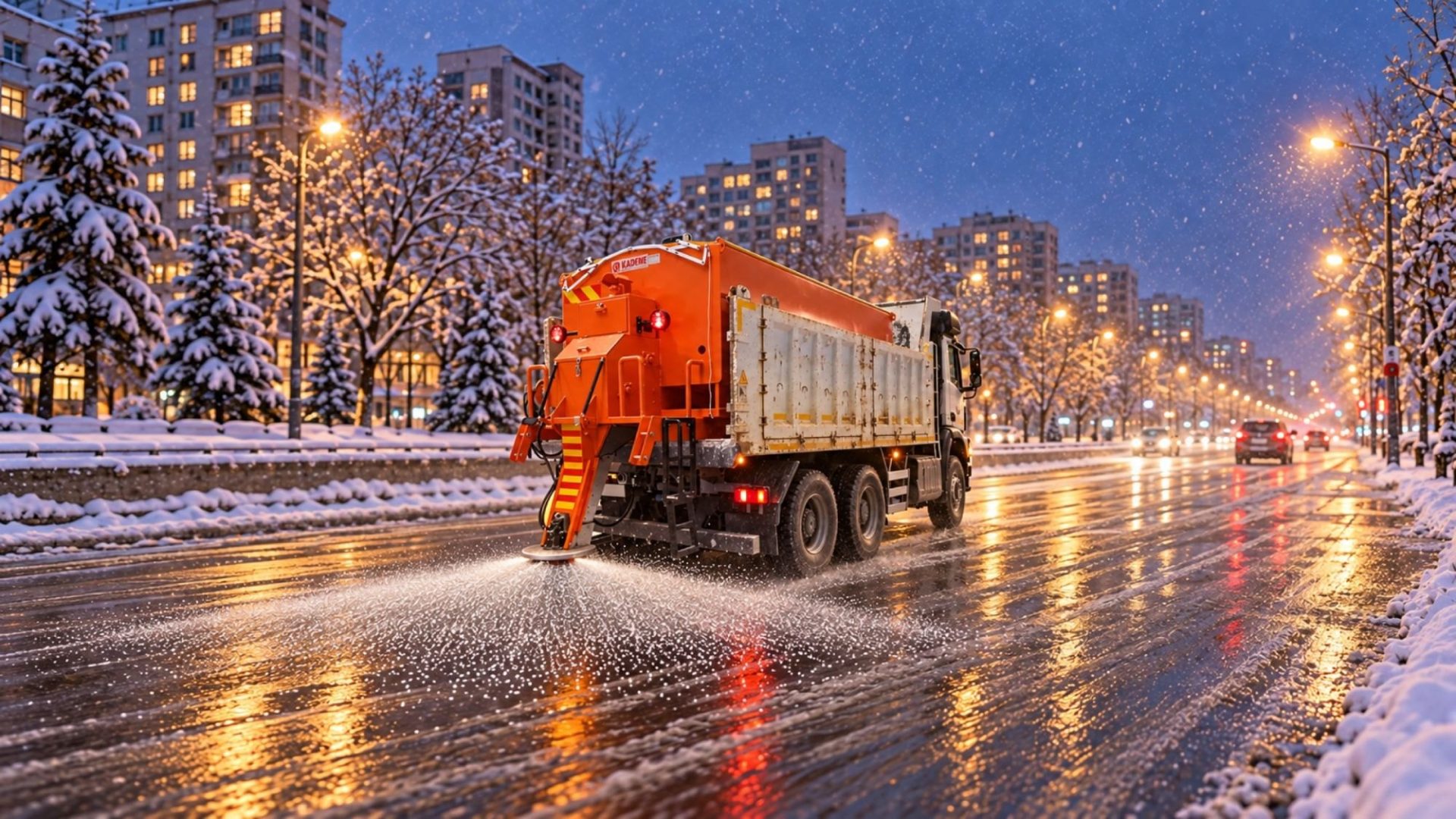
To choose a salt spreader, start with the vehicle that will carry it, then size the hopper, the spread width and the brine tank to your routes. A pickup or light truck suits a small hopper for narrow streets and sidewalks. A heavy truck suits a large hopper for arterial roads. If your winters regularly drop well below freezing, a spreader that can also apply brine extends the temperature range you can treat.
Winter crews usually discover the limits of a spreader on the first cold night. The hopper empties halfway through the route, the spread is too wide for a narrow street, or rock salt stops working as the temperature falls. Each of these comes back to a choice made when the spreader was bought.
What does a salt spreader do?
A salt spreader keeps roads from icing by spreading de-icing material across the surface. Depending on the job, that material is rock salt, a mix of salt and aggregate such as sand, or a liquid salt solution called brine. A snow plough removes the snow, but it leaves a thin layer behind, and that layer turns to ice when the temperature drops at night.
On a Kademe salt spreader, a chain-driven conveyor carries material from the hopper and controls the direction of flow onto the road. The operator sets the spreading width and the amount from a control panel in the cab. The same unit can then treat a wide main road and a narrow access street on one route.
Which vehicle can carry a salt spreader?
Most municipal vehicles can carry a salt spreader with the right mounting parts. The carrier decides how big the spreader can be and where it can go.
| Carrier | How the spreader is mounted | Typical use |
|---|---|---|
| Truck | On the truck body with mounting components | Arterial roads, intercity roads |
| Light truck or van | On the cargo body | Residential streets, industrial areas |
| Pickup | In the pickup bed | Narrow streets, sidewalks, parking lots |
| Trailer | Towed, as a salt spreader or a combined salt and brine spreader | Adding capacity without a dedicated truck |
| Tractor | On the three-point hitch | Parks, rural and village roads |

Kademe lists compatible models by brand. For example, the spreaders fit trucks from Mercedes, MAN, Ford, Fatih and Iveco, and light trucks and pickups from Mercedes, MAN, Ford, Nissan, Iveco and Volkswagen. The spreader runs from the vehicle’s own hydraulic system, so check that your carrier has a hydraulic outlet or can be fitted with one.
How big should the hopper be?
The hopper should be large enough to finish a route without returning to refill, and small enough for the vehicle to carry when full. Kademe salt spreaders come in six hopper sizes, from the 1 m³ SED model to the 7 m³ TEP model, with hopper lengths from 1,500 to 4,000 mm.
Weight is the limit that matters most. An empty Kademe spreader weighs 1,500 to 2,750 kg depending on the model, and a full hopper adds the weight of the salt on top of that. Compare the empty weight plus a full load with the payload printed on the vehicle registration before you choose a size.
For example, a 1 m³ hopper on a light vehicle can cover a short loop of school streets and sidewalks with refills close by. A long arterial route with the depot at one end calls for a 5 to 7 m³ hopper on a heavy truck. The crew then does not lose time driving back empty.
How wide should the spread be?
Set the spread width to the road you are treating, not to the maximum the machine can reach. Kademe spreaders cover a width of 1,500 to 4,000 mm, adjustable from the cab. A single lane or a narrow street needs the lower end of the range. A wide road can be treated in fewer passes at the upper end.
Spreading wider than the road wastes material and throws salt onto sidewalks, parked cars and planted areas. Because the operator can change the width while driving, the same spreader can narrow its pattern at a junction and widen it again on the next straight section.
Salt, brine or both?
Rock salt and brine work at different temperatures, which is why many winter fleets use both. A winter operations document from the Istanbul Metropolitan Municipality reports that its rock salt, bought to the Turkish TS 13158 standard, works down to -8 °C. Its salt brine works down to -20 °C.
Kademe spreaders carry a brine tank of 1,000 to 3,000 lt, and towed units are available as combined salt and brine spreaders on a trailer. Brine stays where it is sprayed, which makes it useful on surfaces that freeze first. For example, a crew can treat bridges and ramps with brine before a cold night and spread salt on the main roads once snow has fallen.
Do you need a snow plough as well?
On roads that get heavy snow, a salt spreader works best behind a snow plough. The plough clears most of the snow, and the spreader treats the thin layer that is left. Spreading salt onto deep snow uses more material for the same result.

A truck can carry both, with the plough on a front mounting plate and the spreader on the body. Kademe snow ploughs come in six models, SED 2000 to SED 3200, with working widths of 1,800 to 3,000 mm and weights of 100 to 750 kg. When you combine the two, check the front axle load for the plough and the rear axle load for the full spreader together.
Which standards apply to salt spreaders?
In Europe, the design and construction of winter spreaders is covered by EN 15597-1:2020. The standard sets requirements for bulk spreaders, sprayers, trailer spreaders and towed spreaders with speed-related spreading, and it defines what the operating manual must contain. A second part, EN 15597-2, covers how evenly a spreader distributes material and how that is tested. If you are writing a tender, these standards give you a common reference for comparing offers.
Where should you start?
Start with a list of your winter routes and the vehicles available to run them. For each route, note its length, its widest and narrowest roads and the distance to the salt store. Then match each route to a carrier and choose the hopper size that carrier can take when full.
You can compare models and specifications on the salt spreaders for trucks page. If you send us your routes and vehicles, our sales engineers will reply within 24 hours with a recommendation for each vehicle.
This article gives general guidance. Before you fit any equipment, check the axle loads and payload of your vehicle with its manufacturer or an authorized service center.
Frequently asked questions
Can you put a salt spreader on a pickup truck?
Yes. Kademe salt spreaders can be mounted in the bed of a pickup with the right mounting parts. Choose a small hopper and check that the pickup’s payload covers the spreader and a full load of salt.
Does a salt spreader need the truck’s hydraulics?
Yes. Kademe salt spreaders are driven by the carrier vehicle’s hydraulic system, so the vehicle needs a hydraulic outlet or must be fitted with one.
Can a salt spreader spread sand or gravel?
Kademe salt spreaders can spread a mix of salt and aggregate, such as sand, as well as pure salt. Ask for the right setup if you plan to spread aggregate on its own.
Can a tractor carry a salt spreader?
Yes. Tractor-mounted Kademe salt spreaders attach to the tractor’s three-point hitch, which makes them practical for parks and rural roads.
Where does this information come from?
Kademe specifications come from the Kademe snow and ice control equipment catalog and the salt spreader product page. The temperature ranges for rock salt and brine come from the Istanbul Metropolitan Municipality’s published document on winter road operations. Standard information is based on the published scope of EN 15597-1:2020. This information is current as of November 2026.