How Does a Street Sweeper Work? Vacuum, Mechanical and Regenerative Air Sweepers Explained
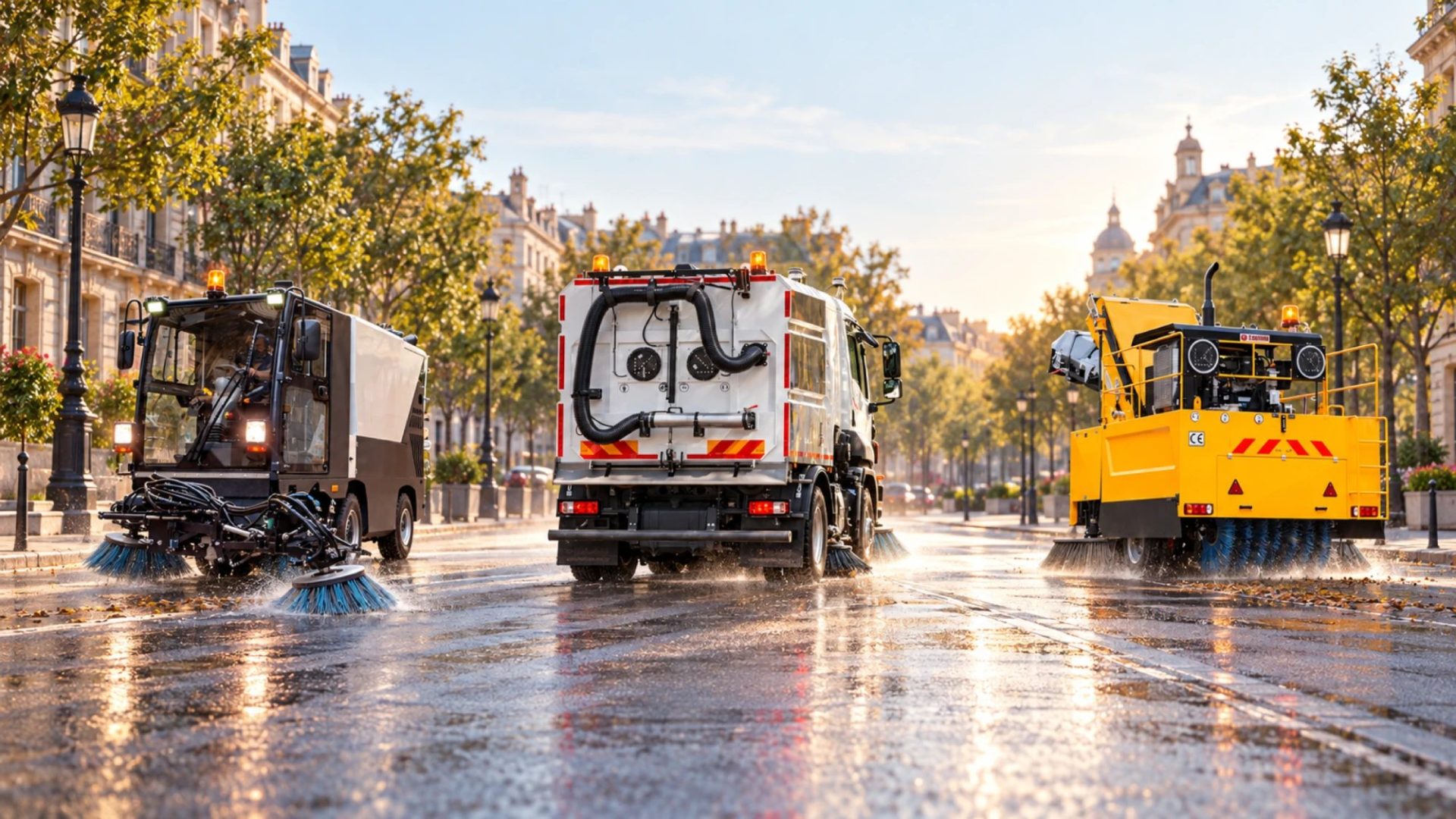
A street sweeper works by loosening debris with rotating brushes, lifting it into a hopper, and keeping dust down with a water spray. The difference between sweeper types is how the debris is lifted. A vacuum sweeper sucks it up through a nozzle with a powerful fan. A mechanical broom sweeper throws it onto a conveyor. A regenerative air sweeper blows air across the road and pulls it back with the debris.
Most people only see a street sweeper from the curb, with its brushes spinning and a fine mist around them. Inside, each type follows a simple sequence, and that sequence decides what the machine is good at. Understanding it helps you match a sweeper to your streets, whether they are narrow cobbled lanes, dusty industrial roads or long arterial routes.
How does a street sweeper pick up debris?
Every street sweeper follows the same four steps. The brushes gather debris, a pickup system lifts it, a hopper stores it, and the machine dumps the load when the hopper is full. A water spray works alongside the brushes throughout, so dust settles instead of rising into the air.
- Gathering. Side brushes, also called gutter brooms, sweep debris out of the curb line and into the path of the machine.
- Lifting. A suction nozzle, a conveyor or an air stream carries the debris up from the road surface.
- Storing. The debris lands in a hopper. Kademe hoppers range from 2 m³ on compact sweepers to 9.5 m³ on truck mounted sweepers.
- Dumping. The hopper tilts and empties into a container, a garbage truck or a collection point.
The lifting step is where the three sweeper types differ, and it is the step that determines how well a machine handles fine dust, litter or heavy material.
How does a vacuum street sweeper work?
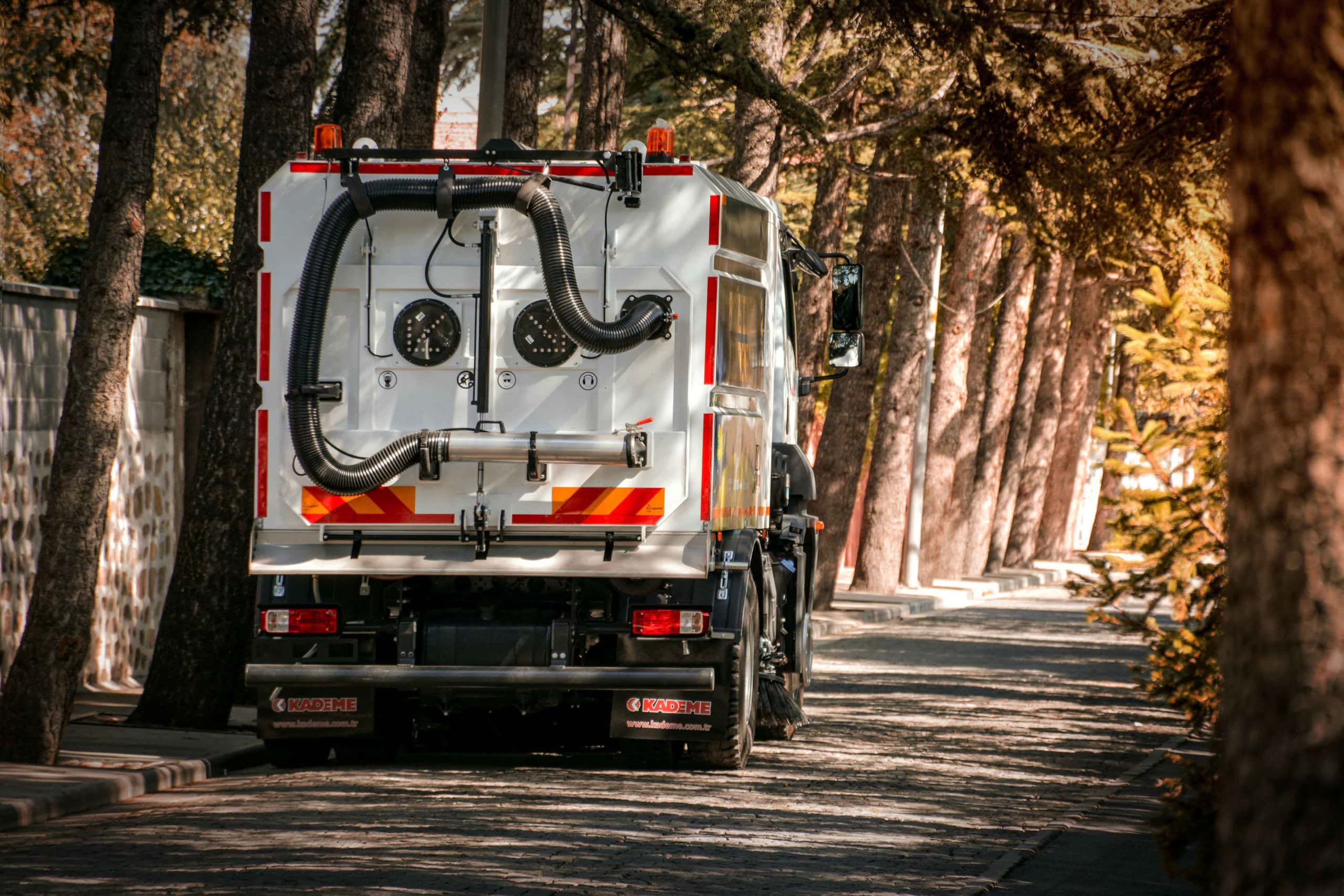
A vacuum street sweeper, also called a suction sweeper, lifts debris with air. The brushes push debris toward a suction nozzle close to the road surface. A fan creates strong airflow that pulls the debris through a hose into the hopper. Inside the hopper, the air slows down, heavy material drops out, and a filter mesh stops lighter particles before the air leaves the machine.
Fan airflow and hose diameter decide how much a vacuum sweeper can lift. For example, the AGA 2100 compact sweeper moves 8,500 m³ of air per hour through a 200 mm suction hose. The larger AGA 6000 moves 13,000 m³/h through a 250 mm hose. Kademe’s truck mounted sweepers also use a 250 mm hose.
Vacuum sweepers handle fine dust, sand, cigarette butts and mixed litter well, which makes them a common choice for daily city center routes. All Kademe compact and truck mounted sweepers are vacuum sweepers, as is the FTH 240 electric litter picker for parks and pedestrian zones.
How does a mechanical broom sweeper work?

A mechanical broom sweeper lifts debris without a suction fan. A large main broom at the rear rotates against the road and throws debris forward onto a conveyor or elevator. The elevator carries the material up into the hopper. Side brushes feed the main broom in the same way as on a vacuum sweeper.
For example, the Kademe URAL truck towed sweeper uses a 900 mm rear brush, three toothed rubber elevator belts and a 700 mm ribbed conveyor belt. A feeding screw moves debris toward the conveyor. Its sweeping width is 3,000 to 3,200 mm, wider than any Kademe vacuum sweeper.
Mechanical sweepers are commonly used for heavy and compacted material such as gravel, sand, soil and construction debris, where a suction nozzle can clog. The CELIK2000 tractor towed sweeper is also brush based. Its specification lists side brushes, a 780 mm main rear brush and a 2 m³ hopper, with no suction fan.
How does a regenerative air sweeper work?
A regenerative air sweeper uses one blower to do two jobs. It blasts air down across the full width of the pickup head, which loosens debris from the road surface. The same air is then pulled back up with the debris into the hopper. After the debris drops out, the air returns to the blower and goes around again, which is where the name comes from.
Regenerative air sweepers clean the whole width of the pickup head at once rather than relying on a narrow nozzle. In North America they are widely used on parking lots and highways. Kademe does not build regenerative air sweepers. Its range covers vacuum and mechanical sweepers.
Vacuum, mechanical or regenerative air: how do they compare?
The three types overlap, and the right one depends on what lies on your roads. The table summarizes the general differences.
| Feature | Vacuum sweeper | Mechanical broom sweeper | Regenerative air sweeper |
|---|---|---|---|
| How debris is lifted | Suction fan and nozzle | Main broom and conveyor | Recirculated air stream |
| Typical material | Fine dust, sand, litter | Gravel, soil, heavy and compacted debris | Fine dust and light debris |
| Typical use | City centers, daily municipal routes | Construction sites, industrial roads, rural roads | Parking lots, highways |
| Kademe models | AGA series, truck mounted sweepers, FTH 240 | URAL, CELIK2000 | Not in the Kademe range |
Many cities run more than one type. For example, a municipality may use vacuum sweepers for the city center every day and a mechanical sweeper after roadworks or storms, when heavy material covers the road.
Are compact, truck mounted and towed sweepers different types?

Compact, truck mounted and towed describe how the sweeper is built and carried, not how it picks up debris. The European standard EN 15429-1, which sets the classification and terminology for sweepers, groups machines as self-propelled, truck mounted, attached sweeping equipment and pedestrian controlled. Any of these can use vacuum or mechanical pickup.
| Kademe model | Build type | Pickup | Hopper | Sweeping width |
|---|---|---|---|---|
| AGA 2100 | Self-propelled compact | Vacuum | 2 m³ | 1,500 to 1,900 mm |
| AGA 3000 | Self-propelled compact | Vacuum | 2 m³ | 2,300 mm |
| AGA 6000 | Self-propelled compact | Vacuum | 5 m³ | 2,000 to 2,300 mm |
| Truck mounted sweepers | Body on a truck chassis | Vacuum | 3.5 to 9.5 m³ | 2,150 to 2,450 mm |
| URAL | Towed by a truck | Mechanical | Not specified | 3,000 to 3,200 mm |
| CELIK2000 | Towed by a tractor | Brush based | 2 m³ | 2,200 to 2,400 mm |
| FTH 240 | Electric litter picker | Vacuum | 240 lt | Not specified |
Build type decides where the machine fits. Compact sweepers turn in narrow streets and on sidewalks. Truck mounted sweepers travel fast between routes and carry larger hoppers. Towed sweepers turn a truck or tractor you already own into a sweeper.
How do street sweepers control dust?
Street sweepers control dust with water. Nozzles near the brushes spray a fine mist so that dust sticks to the debris instead of rising. Kademe sweepers carry water tanks from 300 lt on the AGA 2100 to 2,200 lt on the 9.5 m³ truck mounted sweeper. On vacuum sweepers, the filter mesh inside the hopper adds a second barrier before air leaves the machine.
Fine dust matters for air quality as well as appearance. The European standard EN 15429-3 defines a test that measures how well a sweeper collects PM10 and PM2.5 particles and how much dust it releases while sweeping. If air quality is part of your tender, you can ask suppliers for this test result.
Which type of street sweeper do you need?
Start with the debris on your roads. Mostly dust, sand and litter points to a vacuum sweeper. Mostly gravel, soil or construction waste points to a mechanical sweeper. Then choose the build type for your streets. Compact sweepers suit narrow streets and pedestrian areas, and truck mounted sweepers suit long routes and arterial roads. A towed sweeper makes sense if you want to use a truck or tractor you already have.
Our guide on how to choose the right road sweeper walks through capacity, emissions and service in more detail. You can compare every model on the Kademe road sweepers page, or send us your routes and our sales engineers will reply within 24 hours.
Frequently asked questions
Is a road sweeper the same as a street sweeper?
Yes. Road sweeper, street sweeper and street cleaning truck are names for the same kind of machine. Road sweeper is more common in British and European English, street sweeper in American English.
Why do street sweepers spray water?
Street sweepers spray water to keep dust on the ground. Without water, the brushes would throw fine dust into the air instead of into the hopper.
What happens to the debris after sweeping?
The sweeper dumps its hopper into a container or a garbage truck when it is full. For example, the Kademe AGA 2100 and AGA 3000 can dump straight into a garbage compactor tailgate or a 1,100 lt container.
Can one sweeper handle both fine dust and heavy debris?
A single machine is usually best at one of them. Vacuum sweepers suit fine dust and litter, and mechanical sweepers suit heavy, compacted material. Cities with both kinds of debris often run both types.
Where does this information come from?
Kademe model values come from Kademe product catalogs. The sweeper classification follows the published scope of EN 15429-1 (classification and terminology) and EN 15429-3 (particulate matter collection testing). The descriptions of mechanical and regenerative air sweepers explain how these machine types generally work. This information is current as of November 2026.