How to Write a Tender Specification for a Road Sweeper
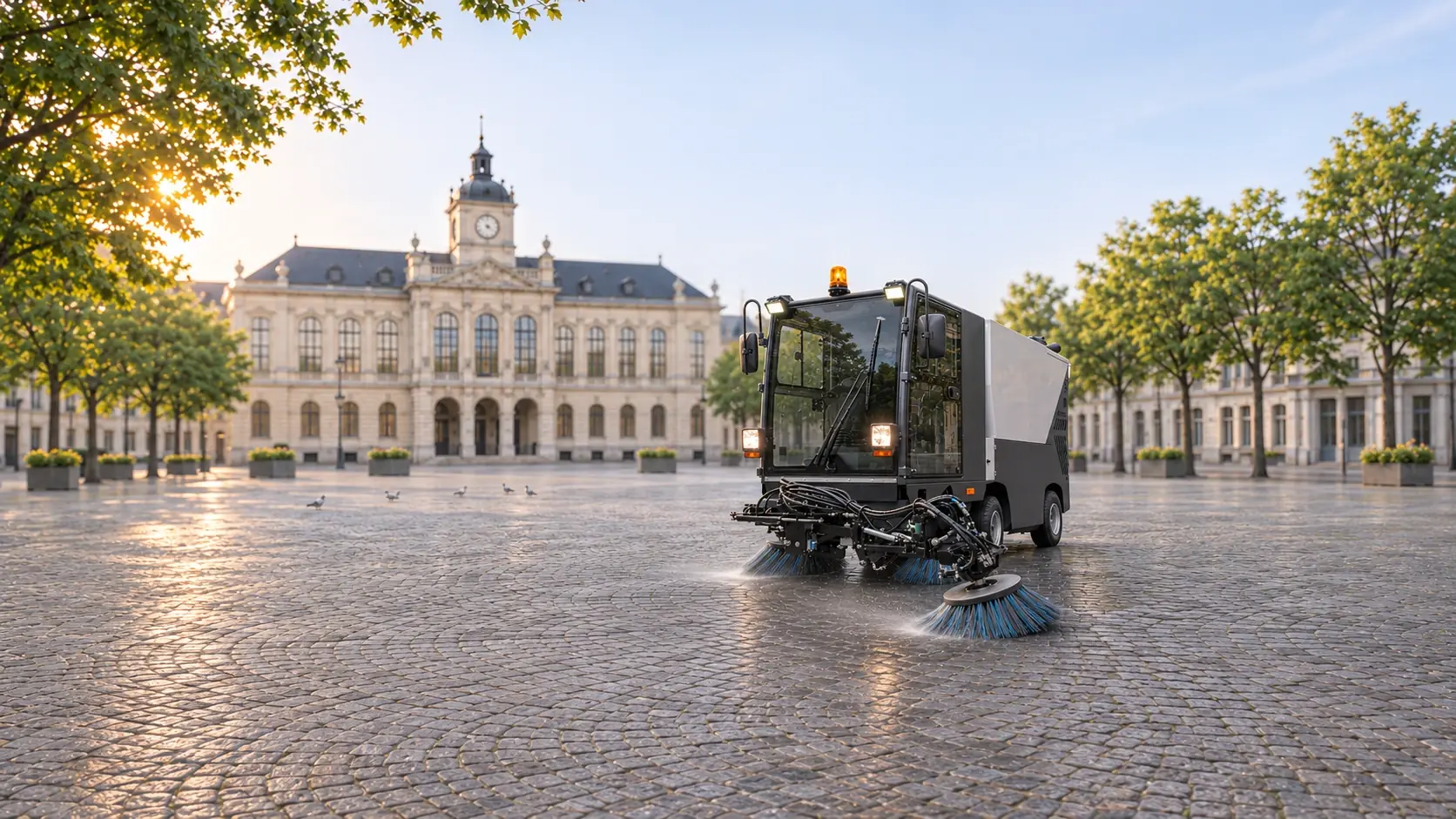
A good road sweeper tender specification describes the work the machine must do, then sets minimum values for the few figures that decide whether it can do that work. Those figures are sweeping width, usable hopper volume, water tank, emission stage, turning circle and dump height. It refers to standards such as EN 15429 with the words “or equivalent” and avoids dimensions that only one model on the market can meet.
Most weak specifications are written backwards. Someone copies the brochure of a machine the city already likes, and the tender ends up describing that machine instead of the streets it has to clean. Bidders then either cannot comply or protest, and the city loses months.
What should a road sweeper tender specification include?
A road sweeper tender specification needs nine parts, and the order matters. The first two describe your city, and only the third starts describing a machine.
- Scope of work. Streets, surfaces, debris types, route length and shift hours.
- Machine class. Compact, truck mounted, towed or pedestrian controlled, with the reason.
- Minimum performance values. Sweeping width, hopper volume, water tank, climbing ability and similar figures.
- Standards and emissions. EN 15429 parts, engine emission stage and CE marking.
- Chassis requirements. For truck mounted sweepers, the minimum chassis rating and axle layout.
- Service, spare parts and training. Response times, parts availability and operator training.
- Documents to submit. Technical data sheet, test reports, declarations of conformity.
- Award criteria. How price, running cost and quality are scored.
- Delivery and acceptance. Delivery place, inspection and a demonstration sweep.
For example, a city that sweeps an old town at night and ring roads by day may need two lots, one for a compact sweeper and one for a truck mounted sweeper. Splitting the tender into lots often widens competition, because more manufacturers can bid on each lot.
Why should the specification start with the job, not the machine?
The European procurement rules point you this way. Directive 2014/24/EU allows technical specifications to be written “in terms of performance or functional requirements”, and Article 42 says specifications must give suppliers equal access to the procedure. A specification that describes the work lets every manufacturer propose its best answer.
Describe the job in plain numbers. Write down the narrowest street the machine must enter, the steepest slope on the route, the surfaces (asphalt, cobblestone, paving), and what you collect (sand, leaves, litter, gravel after winter gritting). Add where the hopper is emptied. A compact sweeper that dumps straight into a 1,100 lt container or a refuse truck tailgate saves a trip to the depot.
For example, “The machine shall sweep pedestrian streets 2.5 m wide with cobblestone paving and dump into 1,100 lt containers” tells bidders far more than “The machine shall be compact”. If you are still deciding between pickup systems, our guide on how a street sweeper works explains vacuum and mechanical sweepers.

Which technical values should you set as minimums?
Set minimums for the values that decide the job, and leave the rest open. The table lists the values that appear in most sweeper data sheets, why each one matters, and the range Kademe’s own models cover, so you can see what a realistic minimum looks like.
| Value | Why it matters | How to write it | Range across Kademe sweepers |
|---|---|---|---|
| Sweeping width | Sets how many passes a street needs | Minimum, with side brushes | 1,500 to 3,200 mm |
| Hopper volume | Sets how often the machine leaves the route to dump | Minimum usable (net) volume | 2 to 9.5 m³ gross |
| Clean water tank | Dust suppression, sets refill stops | Minimum litres | 200 to 2,200 lt |
| Suction hose diameter | Larger debris such as bottles and leaves | Minimum diameter | 200 to 250 mm |
| Climbing ability | Hilly districts | Minimum percent | 25 to 27 percent on compact sweepers |
| Turning circle | Narrow streets and junctions | Maximum diameter | 6,600 to 6,700 mm on compact sweepers |
| Dump height | Dumping into containers or trucks | Minimum height | 850 to 1,600 mm on compact sweepers |
| Hopper material | Corrosion from wet debris | Stainless steel or equivalent, if needed | AISI 304 stainless, aluminium, or plain steel with stainless option |
| Engine emissions | Air quality targets | Minimum emission stage | EU Stage V on compact and truck mounted sweepers |
Ask for usable volume, not only gross volume. The Kademe AGA 3000 Articulated has a 2.3 m³ gross hopper and a 1.1 m³ net hopper, so two machines with the same gross figure can carry very different loads. For truck mounted sweepers, also state the chassis. Kademe’s 3.5 m³ body needs a chassis of at least 7 tonnes and the 9.5 m³ body needs at least 21 tonnes, which our article on street sweeper weight explains in more detail.
Why can sweeping capacity in m²/h mislead a tender?
Sweeping capacity in m²/h is usually a calculated figure, not a measured one. Manufacturers multiply the maximum sweeping width by the maximum sweeping speed. Most of Kademe’s own data sheets follow this rule. The AGA 2100 sweeps 1.5 m at up to 15 km/h, which gives 22,500 m²/h, and the URAL towed sweeper sweeps 3.2 m at 22 km/h, which gives 70,400 m²/h.
Real work is slower. Operators sweep below top speed in dirty gutters, overlap passes, stop for parked cars and drive to the dump point. A tender that scores bids on m²/h therefore rewards the widest brush setting and the highest speed on paper.
Write the sweeping width and the working speed you expect instead, for example “minimum 2,000 mm sweeping width at 8 to 10 km/h working speed”. If performance must be proven, ask for test results under EN 15429-2, the European standard that sets performance requirements and test methods for sweepers. A demonstration on one of your own streets during evaluation is even more useful.
Which standards can a sweeper specification refer to?
The EN 15429 series is the European standard set written specifically for sweepers, and it has three parts. EN 15429-1 sets classification and terminology, which helps you name the machine class correctly. EN 15429-2 sets performance requirements and test methods. EN 15429-3 establishes a method to assess the PM10 and PM2.5 efficiency of road sweepers, which matters if your city has fine dust targets.
Engine emissions are a separate question. Regulation (EU) 2016/1628 introduced the Stage V limits for engines in non-road mobile machinery. Kademe lists EU Stage V engines for its compact sweepers and for the auxiliary engines that drive the fan and brushes on its truck mounted sweepers. The truck chassis itself follows road vehicle rules, so state the Euro class you want for the chassis engine separately.
Under Directive 2014/24/EU, every reference to a standard must be followed by the words “or equivalent”. A bidder may then prove compliance with a different but equivalent test or certificate.
How do you avoid a specification only one brand can meet?
Use minimums and ranges, never exact figures copied from one data sheet. Article 42 of Directive 2014/24/EU says specifications shall not refer to a specific make or source unless justified by the subject matter, and any such reference must carry the words “or equivalent”. National rules outside the EU usually say the same.
The quiet version of the problem is harder to spot. A clause such as “hopper 2.3 m³, water tank 200 lt, wheelbase 1,935 mm” names no brand, but only one machine matches all three numbers. Bidders read this as a closed tender, and many will not bid at all.
Take a typical scenario. A city wants a small sweeper for its historic centre and copies a competitor’s brochure. Two manufacturers offer machines that are 50 mm wider and 0.2 m³ larger, and both are disqualified. The single remaining bid is above budget, and the tender is cancelled. Had the city written a maximum vehicle width and a minimum usable hopper volume instead, all three machines could have competed.

What should the specification say about service and spare parts?
Ask for commitments you can check, not for “good after-sales service”. A sweeper spends its life wearing out brushes, filters and suction hoses, so the service clauses decide how many days a year it actually works.
- Spare parts availability, stated in years. Kademe, for example, guarantees spare parts for 10 years.
- Response and repair times, separately for a phone answer, a technician on site and a repaired machine.
- A consumables list with prices, covering side brushes, main brush, filters and hoses.
- Operator and mechanic training at delivery, with the number of trainees and days.
- Operating and maintenance manuals and a spare parts catalogue in your language.
For example, a clause such as “The bidder shall list the price of one set of side brushes and the main brush, valid for three years” lets you compare running costs before you sign.
How should you score road sweeper bids?
Score bids on value over the machine’s life, not on purchase price alone. Article 67 of Directive 2014/24/EU bases awards on the most economically advantageous tender, which may use the best price-quality ratio. Article 68 lets authorities include life-cycle costs such as energy, maintenance and end-of-life costs.
For a sweeper, the life-cycle costs that differ most between bids are fuel or electricity, brushes, filters and service visits. An electric compact sweeper such as the AGA 3000 Electric has no diesel bill, and that saving only counts if running costs are part of the award.
For example, a city might weight price at 60 points, five-year running cost at 25 points and service commitments at 15 points. Whatever split you choose, publish the formula in the tender documents so bidders know how they will be scored.
How do you check the sweeper at delivery?
Write the acceptance test into the specification, so both sides know it in advance. Measure the sweeping width and hopper dimensions, check the documents against the bid, and run a demonstration sweep on a real street with your own operator.
For example, a clause such as “Acceptance includes a one hour demonstration on a street chosen by the authority, with the hopper emptied into the authority’s container” catches a wrong dump height on day one, not after the warranty starts.
Where should you start?
Start with a map, not a brochure. List your three hardest routes, with the narrowest street, the steepest slope and the dump point for each, and write the scope of work from that list. The machine values in the table above then follow from the streets.
Our guide on how to choose the right road sweeper compares the main sweeper types. If you send us your draft specification, our sales engineers will reply within 24 hours with the Kademe models that meet it.
This article gives general guidance. Public procurement rules differ by country and by the value of the contract, so check your draft with your procurement or legal department before you publish the tender.
Frequently asked questions
Can a road sweeper tender name a brand?
Only in exceptional cases. Directive 2014/24/EU allows a reference to a make only when the subject matter justifies it and the specification cannot be described precisely otherwise, and the words “or equivalent” must follow.
What is the difference between gross and net hopper volume?
Gross volume is the full internal volume of the hopper, and net volume is what the machine can actually fill with debris. Ask for net volume in the tender, because some designs lose much of the gross volume to filters and water tanks.
Should a tender ask for PM10 performance?
Ask for it if your city has fine dust targets. EN 15429-3 sets a test for how well a sweeper collects PM10 and PM2.5, and you can request the results with the words “or equivalent”.
Can we specify an electric road sweeper?
Yes, describe the shift length and route instead of a battery size. The Kademe AGA 3000 Electric, for example, uses a 96 V 640 Ah lithium iron phosphate battery with a 10 kW onboard charger.
Where does this information come from?
Procurement rules come from Directive 2014/24/EU, Articles 42, 67 and 68, published on EUR-Lex. Standard titles and scopes come from the published EN 15429-1, EN 15429-2 and EN 15429-3 records, and the Stage V reference from Regulation (EU) 2016/1628. Kademe values come from Kademe product specifications. This information is current as of November 2026.